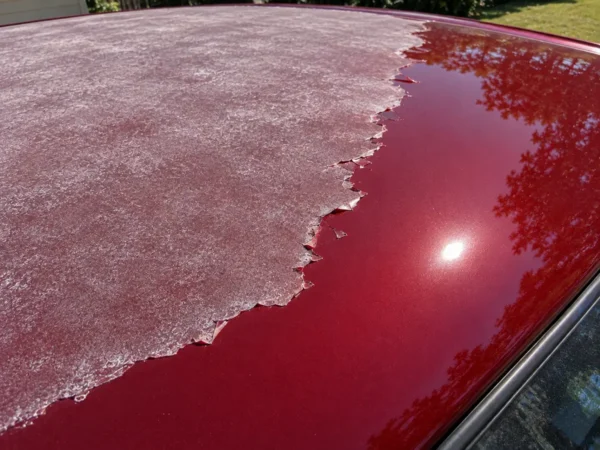
Peeling Clear Coat: Can It Be Fixed or Does the Panel Need Paint?
The short answer: Peeling clear coat can’t be glued back down, and it won’t stop on its own. Once the clear layer starts lifting, the only lasting fix is to remove the failing finish from the affected panel and refinish it. That means new basecoat color and new clear coat, blended so it matches the rest of the car. A touch-up or spray-can clear can make a small spot look better for a while. The edge of the old clear usually keeps lifting, though, especially on panels that sit in strong sun.
Below is how to tell how far along your paint is, what each stage needs, and how to protect a new finish so you don’t pay for it twice.
What peeling clear coat actually is
Most modern cars use a basecoat/clearcoat finish. A thin layer of color (the basecoat) sits under a thicker, transparent clear coat. The clear coat does the heavy lifting. It gives the paint its gloss and it takes the beating from sunlight, heat, water and chemicals.
Peeling happens when the clear coat loses its bond with the color underneath. It starts as a hazy or milky patch. Then it cracks, and finally it lifts in flakes or sheets, exposing flat, dull color below.
Peeling is easy to confuse with oxidation, which is chalky fading that often buffs out. There’s a simple fingertip test in our guide on how to tell peeling from oxidation. If you can feel a hard ridge where the clear coat ends, it’s peeling.
Why sun-exposed panels fail first
Clear coats contain additives that absorb ultraviolet light and slow down the breakdown of the coating. Over years of exposure those protective additives are used up. After that, the clear coat is more likely to lose gloss, crack and eventually delaminate.
That is why peeling almost always shows up first on the horizontal surfaces that face the sky: the roof, the hood, the trunk lid and the tops of fenders. Doors and lower panels usually hold up much longer.
A few things speed the process up:
- Hours of direct sun and summer heat. Southern Arizona’s intense sun is hard on any finish, especially on cars parked outside every day.
- Chips and scratches that go through the clear. They give the edge of the clear coat a place to start lifting.
- Harsh washing. Abrasive polishes, brushes and heavy-duty pressure washing can wear the clear coat thin or lift an edge that is already weak.
- An earlier repaint with poor preparation. If the previous refinish didn’t bond well, it can peel much sooner than factory paint.
The three stages, and what each one needs
| Stage | What you see | What it needs |
|---|---|---|
| 1. Hazing / early failure | Dull, cloudy or milky patches. The surface is still smooth, with no lifting edge. | Have it looked at. Sometimes a professional can polish and protect the finish to slow things down, but a hazing clear coat is already losing its protection. Plan for a refinish. |
| 2. Cracking and small lifting spots | Fine cracks, rough texture and small flakes, usually on one panel. | A panel refinish. This is the least expensive time to fix it, before the color underneath is damaged. |
| 3. Widespread peeling | Large sheets of clear coat gone, faded or chalky color, sometimes bare primer. | Refinish of each affected panel. If several panels are involved, the shop may recommend painting more of the car so the color stays consistent. |
The pattern is simple: the longer peeling goes, the more of the panel it takes with it. Once the clear is gone, the basecoat is exposed to sun and weather with nothing protecting it. Primer and bare metal come next.
Why touch-ups and spray cans rarely last
It’s tempting to sand the flaking area, spray some clear and call it done. On a small, low-visibility spot, that may buy some time. It rarely lasts, for three reasons:
- The old edge is still failing. New clear sprayed over a patch sticks to the original clear around it, and that clear has already lost its bond with the color. The lifting just moves outward.
- The basecoat is very thin. Trying to sand or “feather” the peel edge by hand makes it easy to cut through the color and into primer, turning a clear coat problem into a color-matching problem.
- The patch shows. A spot repair leaves a visible transition line and a difference in gloss. On a roof or hood, that’s usually the first thing you see.
Use a DIY or spot fix only as a temporary cosmetic step on a car you don’t plan to keep long. If you care about how the car looks or what it’s worth, a professional refinish is the fix that holds.
What a proper refinish involves
A quality refinish is mostly preparation. The steps usually look like this:
- Inspect and map the damage. The painter checks how far the failure has spread, including areas that look fine but are starting to haze.
- Remove the failing finish. The loose, peeling clear coat is sanded off down to a sound, well-bonded layer. Where the color or primer is damaged, the area is repaired and primed.
- Match the color. The factory paint code is the starting point. Sun-faded paint rarely matches the code exactly, so the painter tints and tests the color against the car itself.
- Apply basecoat and clear coat. Fresh color goes on, followed by new clear coat. The clear coat is what protects the finish from here on.
- Blend into neighboring panels when needed. To avoid a visible line between old and new paint, the new color is often blended into the adjacent panel. Learn more about how paint blending works.
- Finish and inspect. The surface is checked for texture, gloss and color match in good light before the car goes home.
At Formula 1 Collision Center, refinish technicians have trained directly with PPG and I-CAR, and the shop sprays PPG’s ENVIROBASE® High Performance waterborne system, which includes its own undercoats and clearcoats. See our auto body paint refinishing in Tucson page for details on the process.
Protecting a new finish in a hot, sunny climate
A new clear coat needs time to fully cure, and how you treat it early matters. Formula 1 Collision Center’s finish care guidance for the first 60 days after pickup is:
- Don’t use automatic car washes, brushes or high-pressure sprayers.
- Don’t apply wax or silicone products.
- Do wash by hand with a garden hose and mild detergent, and dry with a soft towel or microfiber cloth.
After that, a few habits will help the finish last in the desert:
- Park in shade or a garage when you can, or use a breathable car cover on long-term outdoor parking.
- Wash regularly and gently. Dust, bird droppings, tree sap and bugs are easier on paint when they don’t bake on for weeks.
- Add protection once the paint is cured. A quality wax or sealant, reapplied on schedule, adds a layer that takes some of the sun instead of your clear coat.
- Fix chips early. A chip through the clear gives peeling a place to start.
Is peeling covered by a paint warranty?
It depends on why it’s peeling.
- Factory paint that peels after years in the sun is usually treated as wear and environmental exposure, not a defect. Check your vehicle’s paint or corrosion warranty for the exact terms.
- A previous repaint that peels early may be covered by the shop that did it, if it offered a workmanship warranty.
At Formula 1 Collision Center, paint refinishing labor is covered by our Lifetime Limited Warranty against peeling, cracking, checking or hazing caused by defective workmanship, for as long as you own the vehicle. Like most workmanship warranties, it does not cover environmental damage such as acid rain, chemical fallout, birds, insects or plants. It also doesn’t cover damage from abrasive polishes, heavy-duty pressure washing or poorly maintained automatic car washes. Following the finish care guidance above protects both your paint and your coverage.
Get your clear coat checked before it spreads
If your roof or hood has started to haze or flake, the sooner it’s refinished, the less of the panel it takes with it. Formula 1 Collision Center has been refinishing vehicles in Tucson for more than 40 years. Call (520) 369-4291 or request an estimate and we’ll look at the damage and explain your options.