Subaru Collision Repair: What Every Owner Should Know
The short answer: Repairing a Subaru after a crash takes more than fixing the dents. Most newer Subarus have EyeSight, a driver-assist system that uses cameras behind the windshield, and Subaru’s service information requires EyeSight to be calibrated after common repairs such as a windshield replacement, suspension work or a wheel alignment. A proper Subaru repair also includes computer scans before and after the work, follows Subaru’s published repair procedures and uses parts that fit and protect like the originals. Subaru Certified Collision Centers are set up to do all of this.
Here is what is different about a Subaru repair, what to ask for, and what your rights are with your insurance company.
Why repairing a Subaru is different
Every modern car is harder to repair than it looks, but Subarus have a few things that make the details matter more:
- EyeSight Driver Assist Technology. Subaru says EyeSight uses dual color cameras mounted near the rearview mirror to run features such as adaptive cruise control with lane centering, lane departure warning and Pre-Collision Braking, according to Subaru’s EyeSight overview. If the cameras aren’t aimed exactly right, those features can react too late, too early or not at all.
- Other sensors. Depending on the model, there may also be radar sensors for blind-spot detection and rear cross-traffic alerts, sensors in the bumpers and steering-responsive headlights.
- Factory repair procedures. Subaru publishes repair procedures for its vehicles, and they change as new models arrive. A shop has to look them up for the exact vehicle, not repair from memory.
These systems are a big part of why repairs on newer cars cost more than they used to. We explain the general picture in our guide on how driver-assist technology affects repair costs.
When EyeSight needs to be calibrated
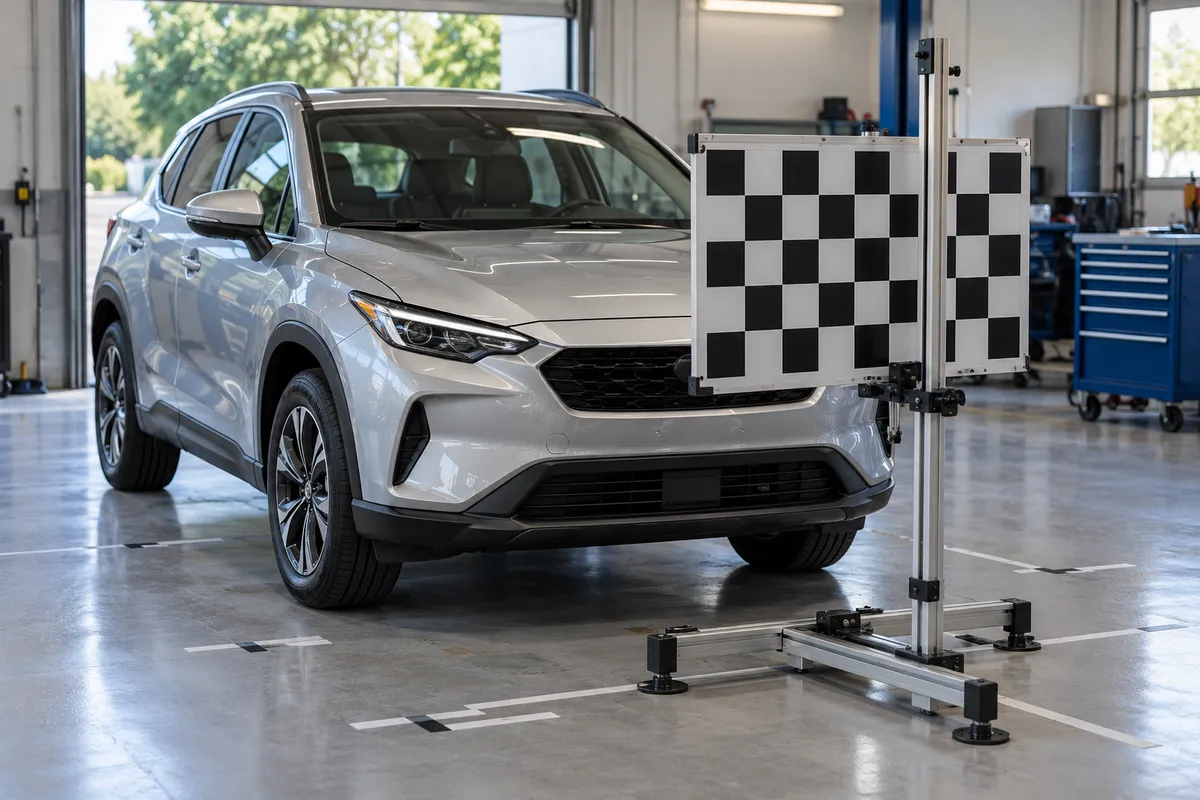
Calibration means aiming and testing the EyeSight cameras with the right equipment and procedure so the system “sees” the road correctly again. According to Subaru service information summarized by I-CAR’s repair research, EyeSight calibration is required when:
- The windshield is removed or replaced
- The EyeSight camera is removed or replaced
- Suspension components are removed or replaced
- A wheel alignment is performed
Subaru also warns that the camera’s aim can shift even in a minor collision. That means calibration may be needed even when no warning light comes on and EyeSight seems to work normally.
In practice, many Subaru collision repairs touch at least one of these items. A front-end hit often needs an alignment, and a cracked windshield is common in crashes. So ask about calibration on any Subaru repair with EyeSight, and ask for the calibration report when you pick up the car.
Pre- and post-repair scans
Modern cars store fault codes in many computer modules, and some faults don’t light up a warning on the dash. Subaru has published a position statement on pre- and post-repair scanning for 2004 and newer models, as reported by Repairer Driven News.
- A pre-repair scan finds electronic damage early, so it can be included in the estimate instead of showing up halfway through the repair.
- A post-repair scan confirms that the repaired systems are working and that the needed calibrations and resets were done.
If your estimate doesn’t mention scans, ask why.
Genuine Subaru parts and EyeSight glass
Subaru recommends Genuine Subaru Collision Parts for collision repairs. On its certified collision center page, Subaru describes them as nearly identical to the parts installed at the factory, crash-tested, and designed for original fit and appearance.
Glass matters too. Because the EyeSight cameras look through the windshield, the glass has to be clear and distortion-free where the cameras see. Ask whether a replacement windshield is the right glass for an EyeSight vehicle, and make sure it’s calibrated afterward.
Insurance policies don’t always pay for new genuine parts. Some allow aftermarket or recycled parts, so read your policy and talk to your adjuster. Our guide to OEM vs. aftermarket parts explains the trade-offs in more detail.
What a Subaru Certified Collision Center has to do
Subaru runs a certified collision network. According to Subaru’s certified collision center page, shops in the network must:
| Requirement | What Subaru says |
|---|---|
| Training | Achieve I-CAR Gold certification |
| Repair methods | Follow official Subaru repair procedures, which are updated regularly |
| Tools and equipment | Have tools and equipment assessed every year |
| Inspections | Pass on-site inspections twice a year |
| EyeSight | Be able to calibrate EyeSight after repairs |
| Before delivery | Complete a mandatory multipoint safety inspection |
You don’t have to use a certified shop, but it is the easiest way to know the shop has Subaru’s procedures, training and equipment.
Formula 1 Collision Center is a Subaru Certified Collision Center in Tucson and the preferred certified collision center for Tucson Subaru. Our technicians are I-CAR certified and trained on Subaru-specific repairs, and we use Genuine Subaru parts. We also subscribe to AllData and I-CAR and access manufacturer repair recommendations and position statements for each repair.
Your rights with your insurance company
Your insurer may recommend a shop, but in Arizona you decide where your car is repaired. State law (A.R.S. § 20-468) gives a person the right to choose any repair facility for a motor vehicle loss, and an insurer that recommends a shop must tell you about that right at the same time.
Subaru’s own list of owner rights adds two more things you can ask for:
- That your insurer and repair shop use only new Genuine Subaru Collision Parts
- A written repair estimate before you authorize any repairs
Not sure whether to go with the shop your insurer suggests? Read our guide on whether to use an insurance-recommended shop.
Questions to ask before you approve a Subaru repair
Use this checklist when you talk to any shop:
- Are you a Subaru Certified Collision Center?
- Will you follow Subaru’s repair procedures for my exact model and year?
- Will you do a pre-repair scan and a post-repair scan?
- Does my repair need EyeSight calibration, and will I get the calibration report?
- Will you use Genuine Subaru Collision Parts? If my policy calls for other parts, which ones and why?
- If the windshield is replaced, is the glass right for EyeSight?
- Will you do a road test and a final safety inspection before I pick up the car?
- What warranty covers the repair? (Ours is a Lifetime Limited Warranty on workmanship for as long as you own the vehicle.)
Subaru collision repair FAQ
Does my Subaru need EyeSight calibration after a fender bender?
It might. Subaru warns that the camera’s aim can shift even in a minor collision, and the repair itself may trigger calibration if it includes a windshield, suspension parts or a wheel alignment. Ask the shop to check the repair procedure for your vehicle.
Can any body shop repair a Subaru?
Any licensed shop can work on a Subaru, and you have the right to choose. The question is whether the shop has Subaru’s repair procedures, scan tools and calibration equipment. Subaru’s certified network requires them.
Is EyeSight calibration covered by insurance?
When calibration is a required part of repairing covered damage, it is normally included in the repair estimate. Coverage depends on your policy and claim, so confirm it with your adjuster.
What happens if EyeSight isn’t calibrated?
The system may not work correctly. It could warn too late, brake when it shouldn’t, or turn itself off. That’s why the calibration report should be part of your paperwork when you pick up your car.
Get your Subaru repaired the right way
If your Subaru has been in a collision, our team at Formula 1 Collision Center in Tucson can inspect it, follow Subaru’s procedures and work with your insurance company. Call us at (520) 369-4291 or request an estimate.